Bonjour lecteurs! Central Europe has a remarkable habit of revealing its history in layers. Medieval lanes run beneath baroque façades. Former royal residences stand beside lively cafés, and grand railway stations still hint at the importance of past powerful empires. Prague, Vienna and Budapest form a particularly compelling sequence. Each developed its own language architecturel and cultural traditions. They were all shaped by centuries of political connections across the region. From the Bohemian crown to the Danube Empire, it’s the Central Europe’s historic passage you need to experience once in a lifetime.
Prague’s Gothic Heart
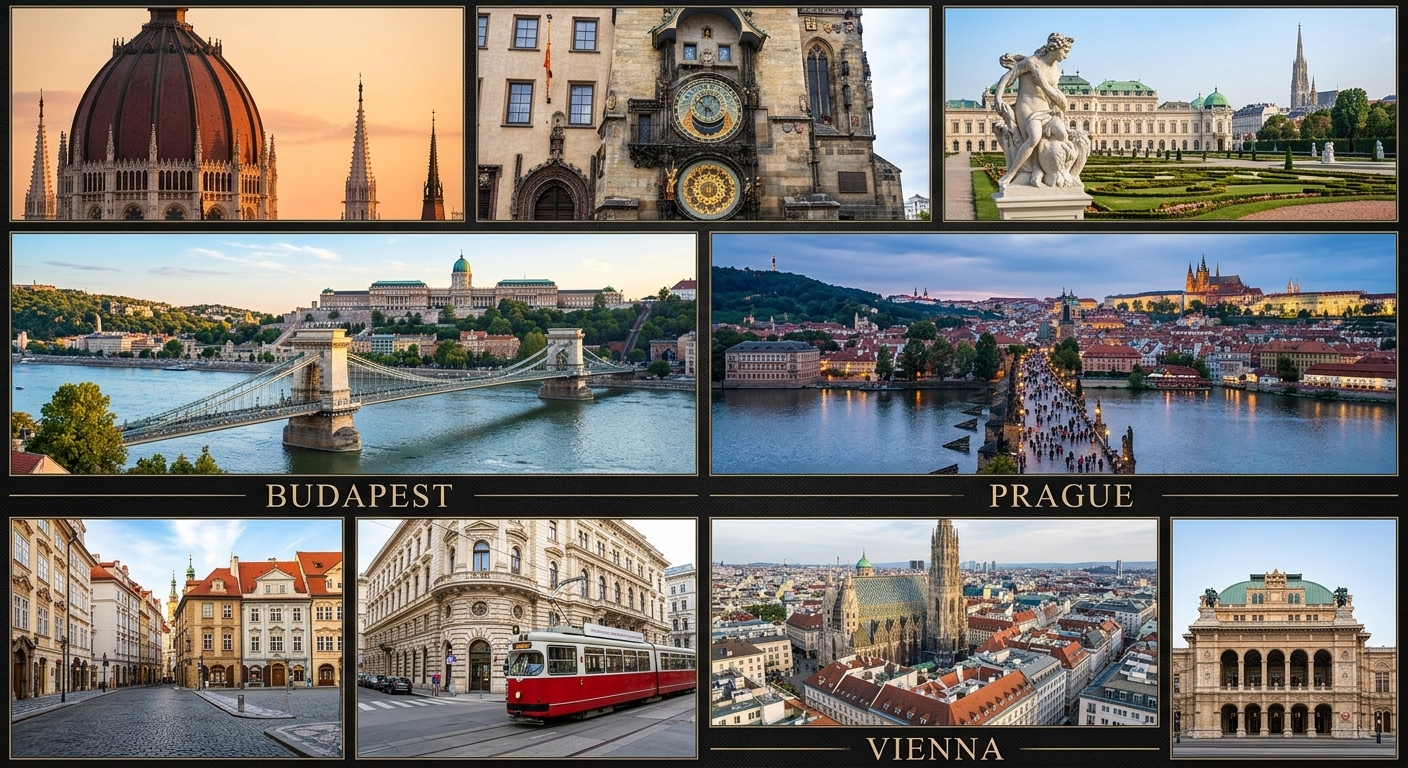
Prague’s historic centre feels almost theatrical, particularly around the Old Town Square. Gothic towers and baroque churches surround the plaza, while the Astronomical Clock draws attention to the city’s long relationship with science, craftsmanship and civic life.
Charles Bridge offers une autre perspective. Its stone arches cross the Vltava beneath a collection of statues, connecting the Old Town with the slopes leading towards Prague Castle. Early morning is particularly atmospheric, when the river is quiet and the bridge has a more contemplative character.
Don’t forget Prague Castle that occupies an extensive complex of courtyards, palaces and religious buildings.
Along the Road to Vienna
The train from Prague to Vienna provides a natural transition between two former imperial capitals. Leaving Prague behind, the urban landscape gradually gives way to the countryside of southern Moravia and the approaches to Austria.
Bohemia and the Austrian lands were once governed within the Habsburg world, and cultural influences crossed their borders for generations.
Arriving in Vienna introduces a striking change in scale. The Austrian capital is defined by broad avenues, monumental buildings and formal squares. You can still witness the vestiges of the European empire.
Vienna in Imperial Proportion
Vienna’s Ringstrasse provides one of the clearest expressions of imperial ambition. The grand boulevard encircles the historic centre, passing the State Opera, Parliament and Rathaus. Those times were of a rapid urban transformation.
The Hofburg remains at the heart of the city. Once the principal residence of the Habsburg rulers, its extensive complex now contains museums, ceremonial spaces and the Austrian National Library.
Yet Vienna is not simply a collection of monumental buildings. Neighbourhood cafés, small wine taverns and local markets reveal a more relaxed side of the capital.
The Danube Connection
The Danube provides the geographical thread linking Vienna with Budapest. For centuries, la rivière served as a commercial artery, transporting goods and connecting communities across Central Europe.
Today, the waterway remains central to both capitals. In Vienna, riverside districts provide space for cycling and recreation, while Budapest has developed some of its most recognisable views along the Danube itself.
The river also helps explain why these cities became such important centres. It was a real economic and political hub.
Budapest Across Two Shores
The train from Vienna to Budapest makes the transition from Austria into Hungary straightforward, with the landscape gradually changing as the route approaches the Hungarian capital.
Budapest is distinctive because of its division between Buda and Pest. The Danube separates the two sides, while bridges create dramatic connections between them.
Buda rises towards the Castle District, where cobbled streets and historic buildings occupy the hillside.
Castle Hill After Dark
Budapest becomes particularly atmospheric as evening approaches. The illuminated Parliament building reflects across the Danube, while the Buda hills provide an elevated viewpoint over the city.
Fisherman’s Bastion is one of the most recognisable places to admire the panorama. Its pale stone terraces and towers were designed in un style historique, creating a setting that feels older than its actual construction.
The Thermal Tradition
Budapest’s relationship with thermal water is another defining feature. Natural hot springs have been used in the area for centuries. From Roman settlers to later Ottoman rulers both contributed to the bathing culture.
The Széchenyi Baths are among the most famous examples. Their expansive outdoor pools allow visitors to soak in warm mineral-rich water, surrounded by ornate yellow buildings.
Gellért Baths offer a different architectural experience, with decorative interiors inspired by the Art Nouveau period. Bathing was a practical and social part of Budapest’s urban identity.
Flavours Across Three Capitals
Food provides another way to trace the region’s shared history. Czech, Austrian and Hungarian cuisines each have distinctive traditions and still influence la région.
Prague is known for hearty dishes, dumplings and beer culture, while Vienna has become synonymous with schnitzel, pastries and elaborate cakes. Budapest brings paprika, goulash, rich stews and sweet pastries to the table.
Check out the local markets to savour all that the cities have to offer.
Music, Art and the Habsburg Legacy
The cultural influence of the former Habsburg world can still be heard and seen across the three cities. Bien sûr, people associate Mozart to Vienna. Beethoven and Schubert also remains central to its identity. Fro concert halls to historic venues, you’ll witness l’héritage musical.
Prague has its own distinguished musical tradition, strongly associated with composers including Antonín Dvořák and Bedřich Smetana. The city’s theatres and concert venues continue to showcase classical works alongside contemporary performances.
Budapest adds another artistic layer through composers such as Franz Liszt and its flourishing café and literary traditions.
Three Cities, One Historic Thread
Prague, Vienna and Budapest each tell une histoire différente about Central Europe. Prague evokes the medieval Kingdom of Bohemia and the architectural richness of the Czech capital. Vienna recalls imperial courts, grand boulevards and a sophisticated musical culture. Budapest combines the legacy of the Austro-Hungarian era with its own Hungarian identity and the enduring presence of the Danube.
If you are planning a trip in Central Europe, visit them allin a loop for a truly magical experience.
Collaboration